







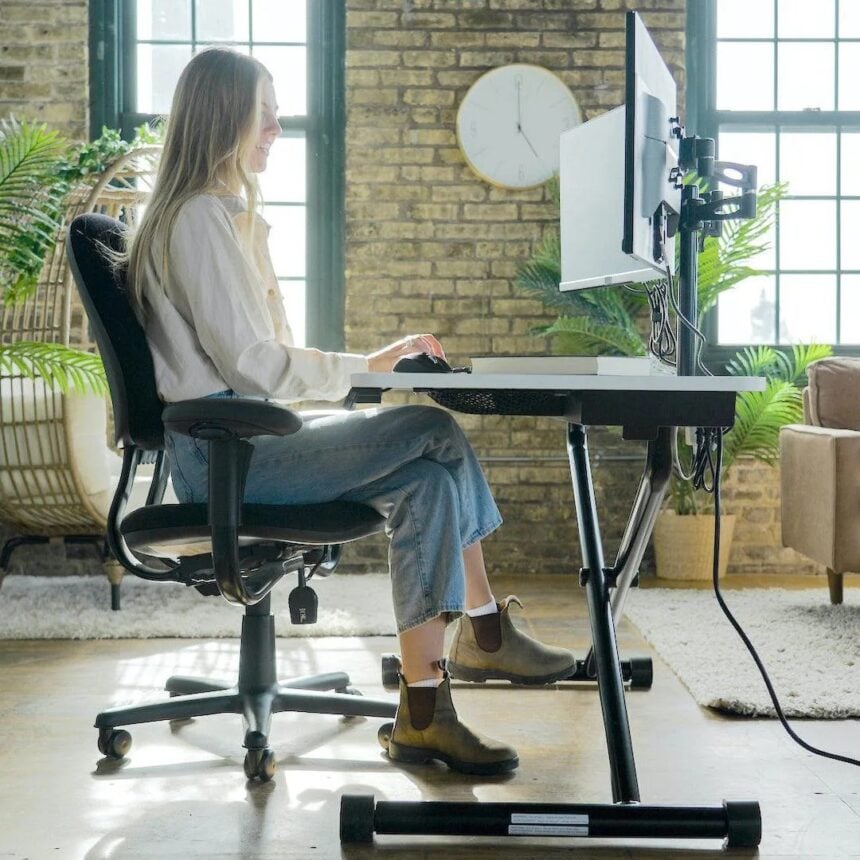
What this covers
-
The Structural Difference
-
What the Wall Actually Has to Be
-
The Renter Constraint
-
What the Wall Desk Gives Up
-
What the Free-Standing Desk Gives Up
-
The Third Option People Forget
-
Choosing Between Them
-
What Happens to Each One Over Five Years
-
The Practical Test Before Ordering
-
The Hybrid Option That Gets Overlooked
-
The Summary
Both solve the same problem. A working surface that is present when needed and absent the rest of the time. They solve it in opposite directions, and the correct answer usually comes down to a question about the building rather than about the desk.
The Structural Difference
A wall-mounted folding desk transfers its load into the wall. A free-standing folding desk carries its own load to the floor.
Everything else follows from that. The wall desk has no legs to work around, no footprint when closed, and no ability to move. The free-standing desk has legs, a footprint, and complete freedom about where it lives.
|
Wall mounted |
Free standing |
|
|
Floor space when closed |
None |
Folded footprint, or storage space |
|
Install |
Permanent fixings required |
None |
|
Height |
Fixed at install |
Can be adjustable |
|
Moves rooms |
No |
Yes |
|
Survives a move |
Usually not |
Yes |
|
Renter friendly |
Often not |
Yes |
|
Load limit set by |
The wall |
The frame |
What the Wall Actually Has to Be
This is the part that gets discovered during installation rather than before it, and it decides whether a wall desk is even possible.
A fixing into a stud, the vertical timber or steel inside the wall, carries a lot. A fixing into drywall alone carries far less, and the rated capacity of a drywall anchor is a pull-out rating under static load, not a rating for a surface that gets leaned on, typed at, and occasionally sat on by somebody who should not be sitting on it.
The mismatch is the problem. A desk might weigh very little and still apply a substantial turning force at the fixing point, because the load sits out at the end of a lever arm rather than flat against the wall. A laptop at the front edge of a 24-inch-deep desk is applying a great deal more turning force at the wall than its weight suggests.
Three cases, in order of how comfortable they should make you:
-
Fixed into studs at the correct spacing. Fine. This is what the mounting hardware is designed for.
-
Fixed into masonry with appropriate anchors. Fine, and often stronger than studs.
-
Fixed into drywall alone with toggle anchors. Possible for a light desk, and the thing most likely to loosen over a year of daily folding.
If the studs do not fall where the desk needs to go, the honest options are to move the desk, add a backing board spanning two studs, or choose a free-standing design. Spacing fixings to miss the studs because that is where the desk looks best is how a desk ends up on the floor.
The Renter Constraint
This decides it for a large share of people before any of the above becomes relevant.
Permanent fixings in a rented apartment range from discouraged to prohibited depending on the lease, and even where they are permitted, the holes are a deposit question at move-out. A wall desk also does not come with you. The fixings stay, the desk comes off the wall, and it is now a desktop with brackets and no home.
For anybody expecting to move within a few years, that is a strong argument for free-standing regardless of the floor-space advantage.
What the Wall Desk Gives Up
Height adjustability, almost always.
A wall-mounted desk is fixed at whatever height it was installed at. That is fine if the installer measured carefully for the person who will use it, and it removes the option of changing position during the day entirely. It also removes the option of a different person using it comfortably.
For a single user in a known position, that is an acceptable trade. For a shared space, or for anybody who wants to alternate between sitting and standing, it is a significant limitation that the floor-space saving does not offset.
What the Free-Standing Desk Gives Up
Pure floor efficiency when closed, and tidiness.
A free-standing folding desk still exists when folded. It goes under a bed, behind a door, into a closet, or against a wall, and all of those are real storage commitments in an apartment that is short of storage. A wall desk folded up is simply not taking any floor space at all, which is a genuinely better outcome if the install is possible.
The gap narrows when the free-standing desk folds very flat. At that point the storage requirement becomes a gap rather than a space, and most apartments have gaps.
The Third Option People Forget
Neither category covers the case where the working position itself is lower.
A floor-level working setup removes the chair, and the chair is frequently a larger floor-space cost than the desk. It also rules out wall mounting entirely, since a desk that sits at floor height has nothing to bolt to. A desk that drops to floor height and folds away is solving the footprint problem twice, once by folding and once by eliminating the chair clearance behind it.
That is a less familiar arrangement in Western apartments and a very space-efficient one, which is why Lillipad, a maker working that lower range, includes it in its roundup of folding desks for small apartment layouts alongside the conventional categories rather than as a separate class of furniture.
Choosing Between Them
|
If this is true |
Choose |
|
You rent, or expect to move within a few years |
Free standing |
|
The studs fall where the desk needs to be, and you own |
Wall mounted |
|
More than one person will use it |
Free standing, adjustable |
|
The room has zero spare floor or storage |
Wall mounted |
|
You want to alternate sitting and standing |
Free standing |
|
The desk needs to move between rooms |
Free standing |
|
The wall is drywall only and the desk is heavy |
Free standing |
What Happens to Each One Over Five Years
Both categories age, and they age differently.
A wall desk’s failure mode is the fixing. Repeated folding is a cycle load on the mounting points, and a fixing that was adequate on day one can work loose over several thousand cycles, particularly in drywall. The desk does not usually fail dramatically. It develops movement, then more movement, and at some point somebody notices the bracket has pulled slightly out of the wall. That is a repair, and it is a repair into a hole that is now larger than it was.
A free-standing desk’s failure mode is the joints. Pivots develop clearance, fasteners loosen, and the desk gradually becomes less rigid. The difference is that all of those are accessible with a screwdriver and most are adjustable. Nothing is buried in a wall.
|
Over five years |
Wall mounted |
Free standing |
|
What loosens |
The fixings, into a fixed hole |
The joints, which are reachable |
|
Who can fix it |
Someone willing to re-drill |
The owner, with a screwdriver |
|
Cost of the fix |
New fixings, possibly a new position |
Usually nothing |
|
What happens on a move |
Stays, minus the desk |
Comes with you |
This is a real argument for free-standing beyond the renting question. The maintenance is ordinary rather than structural, and ordinary maintenance actually gets done.
The Practical Test Before Ordering
Two checks, both cheap, both done before money is spent.
-
Find the studs where the desk would go. A stud finder costs very little. If they are in the wrong place, the wall option has just been answered.
-
Live with the closed footprint for a week. Put a box of the folded dimensions in the storage spot and see whether it is tolerable. For free-standing desks this is the decision, and it is much easier to reverse before the desk arrives.
The Hybrid Option That Gets Overlooked
A third arrangement belongs to neither category and solves the renting problem without giving up the floor-space advantage.
A free-standing desk that stores vertically against a wall, or slides into a gap, uses wall space without fixing to it. Nothing is drilled, nothing stays behind at move-out, and the floor is still clear when the desk is closed.
The trade is that the desk has to be moved to and from its storage position rather than folding in place, which is a few seconds of handling each time. For a desk used daily that is acceptable. For one used several times a day it becomes friction.
Set against the other two, the trade is clear enough. A wall-mounted desk that folds in place costs no floor space and no handling, and it costs permanent fixings. A free-standing desk stored vertically costs no floor space and no fixings, and it costs a few seconds of carrying each time. A free-standing desk that folds in place costs no fixings and no handling, and it costs the folded footprint.
The middle option is frequently the best answer for a renter in a small apartment, and it is the one least likely to be presented as an option, because it is a usage pattern rather than a product category.
The Summary
Wall-mounted wins on floor space and loses on flexibility, permanence and almost everything about renting. Free-standing wins on everything except the floor space it still occupies when closed.
The building usually decides it. Check what is behind the plaster and read the lease before comparing products, because those two facts eliminate one of the two categories in most cases and make the rest of the comparison straightforward.