







What this covers
-
The Stream Versus the Push
-
Why Surface Drying Wants Velocity
-
Why Air Exchange Wants Volume
-
The Stall That Looks Like Enough Equipment
-
The Los Angeles Mix
-
Renting the Pair, Not One Type
-
The Spec That Tells Them Apart
-
Why Static Pressure Matters on a Real Job
-
Reading the Job to Pick the Mix
-
Getting the Mix Right at the Rental Stage
-
The Short Version
Rental listings put centrifugal and axial air movers side by side as if they were two versions of the same thing, picked by price or availability. They are not two versions of the same thing. They are built for opposite tasks, and treating them as interchangeable is a common reason a drying job stalls with a room full of equipment.
Knowing which does what is the difference between a job that dries and a job that hums loudly and does not.
The Stream Versus the Push
The whole difference is in how each machine moves air.
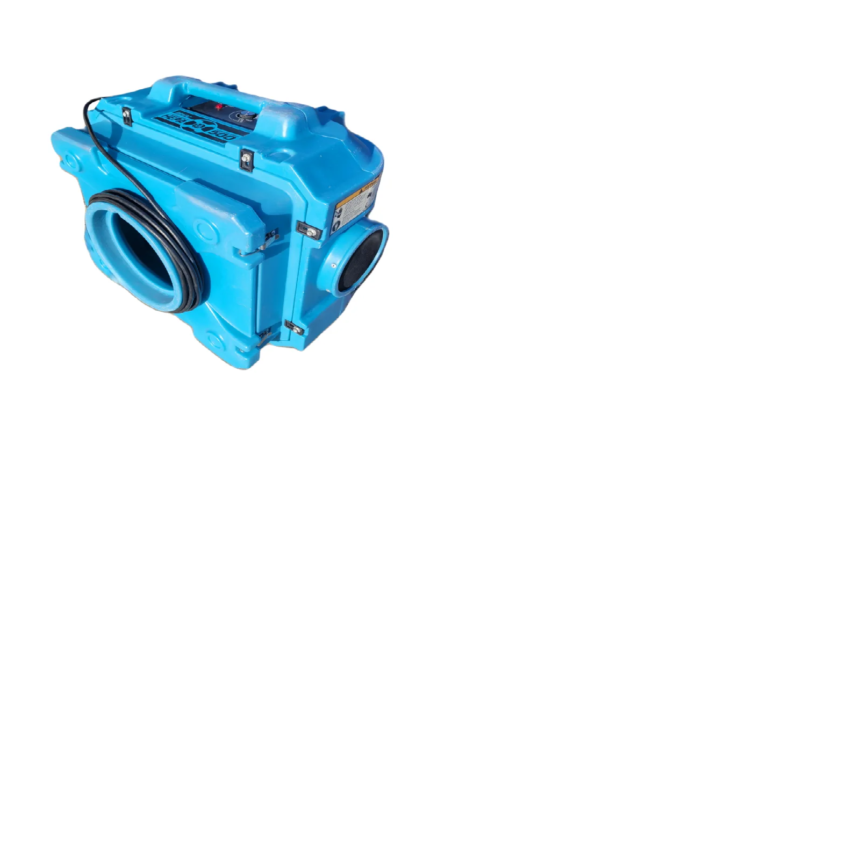
A centrifugal air mover discharges a narrow high-velocity stream. It takes air in at the front, turns it, and throws it out in a tight, fast band. That stream hugs a surface along its length, which is exactly what surface drying needs.
An axial air mover moves a large volume of air at lower velocity. It pushes air straight through, like a fan, shifting a lot of air across a wide front but without the concentrated speed. That is what moving air through a whole space needs.
Same category of equipment, opposite output. One is a focused jet, the other a broad flow.
Why Surface Drying Wants Velocity
Drying a wet surface is about breaking the thin film of still, saturated air against it. Surface drying needs high velocity against the material, because it is the speed of the air at the surface that strips that film and restarts evaporation.
A centrifugal unit’s narrow stream, aimed tight along a wall or across a floor, delivers that velocity exactly where the wet material is. A narrow stream hugs a surface along its length, so one machine can drive fast air along a whole run of baseboard or under a line of cabinets.
Point an axial unit at the same wall and it washes the surface with a lot of air at low speed, which breaks far less of the boundary layer. The wall dries slower with the bigger-sounding machine, because volume is not what the surface needs.
Why Air Exchange Wants Volume
The other half of a drying job is moving the moisture-laden air out of the space so the dehumidifier can take it, and venting where needed. Air exchange needs high volume through the space, and that is the axial unit’s job.
An axial machine shifts the room’s air efficiently, keeping the moisture the surfaces are giving up moving toward the dehumidifier rather than settling. Using a centrifugal unit for this is inefficient the other way: its narrow stream moves a column of air fast but does not turn over the room’s volume the way an axial unit does.
|
Task |
Machine |
Why |
|
Drying a wall, floor, or run |
Centrifugal |
Narrow, high-velocity stream |
|
Moving air through a space |
Axial |
High volume, lower velocity |
|
Venting a room to outside |
Axial |
Shifts large air volume |
|
Under a kick or cabinet |
Centrifugal |
Concentrated stream reaches in |
The Stall That Looks Like Enough Equipment
Here is where the interchangeable habit costs a job. Substituting one air mover type for another leaves a job short, and it does so invisibly, because the site looks fully equipped.
A room full of axial units on a job that needs surface drying washes the walls with air that is too slow to strip the boundary layer, so the surfaces dry slowly while the paperwork shows plenty of machines. The opposite, centrifugal units asked to turn over a large open space, leaves the room’s air under-moved while narrow streams blast a few surfaces.
Either way the count on the drying log looks right and the job runs long, and the reason is a type mismatch that no one recorded, because the log counts machines, not what kind.
The Los Angeles Mix
Local building stock makes the right mix matter. Older plaster-walled rooms with deep baseboards and fitted cabinetry need the centrifugal stream to reach the wet material behind obstructions, while open-plan spaces and converted commercial floors, common across the city, need axial volume to keep the air turning over. A single-type setup struggles with the variety of the housing stock here, where one job is tight older rooms and the next is a wide open floor.
A drying setup that carries both, and uses each for its own task, handles that variety. One that carries only what was on the van does not.
Renting the Pair, Not One Type
Because the two do different jobs, a rental fleet that stocks only one forces a compromise on every job that needs the other. LA Restoration Rentals holding both centrifugal and axial units means a job can put narrow high-velocity machines on the wet surfaces and volume machines on the air exchange, which is the combination the physics actually calls for. A supplier who asks what you are drying, not just how many you want, is matching the machine to the task. The Los Angeles coverage is on the Google Business Profile.
The Spec That Tells Them Apart
If the listing does not say which type a machine is, the specifications give it away, and knowing which number to read keeps you from renting the wrong one.
Centrifugal units quote a high static pressure, because a static pressure is the ability to push air against resistance, through ducting or into a tight space, which is what the focused stream needs. Axial units quote a high airflow volume, often a large cubic-feet-per-minute figure, because moving a lot of air is their job, and they do it at low static pressure. A machine with a big volume number and a low pressure number is axial. A machine built to push against resistance is centrifugal.
The mistake is reading the airflow volume alone and picking the biggest number, which lands you on an axial unit for a job that needed the centrifugal’s surface velocity. The volume number describes air moved through a space, not air driven across a wet surface, and those are the two different jobs.
|
Spec |
Centrifugal |
Axial |
|
Airflow volume |
Lower |
High |
|
Static pressure |
High |
Low |
|
Built for |
Driving air against resistance |
Moving a room’s air |
Why Static Pressure Matters on a Real Job
Static pressure is not an abstract spec. On a real job, the air often has to go somewhere with resistance: through a length of ducting to reach under a floor, into the gap under a cabinet, or against the back-pressure of a tight space. A machine with low static pressure, an axial unit, loses most of its output the moment it meets that resistance.
A centrifugal unit holds its output against resistance, which is why it is the machine for getting air into the places water hides. Rent an axial unit and try to push its air through ducting to dry under a floor, and very little comes out the far end. The job that needed pressure got a machine built for volume, and the drying stalls in the hidden spots while the open room dries fine.
Reading the Job to Pick the Mix
The practical method is to look at the job and count the two kinds of work. Wet surfaces behind obstructions, runs of baseboard, areas under cabinets, floors to be dried along their length: that is centrifugal work, and you count the linear feet of it. Large volumes of air to turn over, open rooms to keep moving, spaces to vent: that is axial work, and you count the volume.
Most real jobs have both, in different proportions. A tight older home with deep baseboards is mostly centrifugal work with a little air exchange. A large open floor is mostly axial work with a few surfaces. Sizing the rental means counting each kind separately and bringing the right number of each, rather than bringing a stack of one type and hoping it covers both.
Getting the Mix Right at the Rental Stage
The mistake this article is really about is treating air movers as a single count, a number of machines for a job, rather than two kinds of machine for two kinds of work. The rental conversation that avoids it is about what you are drying, not just how many units you want.
Describe the job and the mix falls out. Tight older rooms with deep baseboards and fitted cabinetry are mostly centrifugal work, because the wet material is behind obstructions the narrow stream has to reach. Large open spaces are mostly axial work, because the air in the volume has to keep turning over. Most real jobs are a blend, and the right rental brings both in the proportion the job calls for.
A supplier who asks what you are drying, surfaces behind obstructions or a large volume of air to move, is sizing to the work rather than handing over a stack of whichever type is on the shelf. The job that goes wrong is the one equipped with a single type, where axial units are asked to dry surfaces they cannot reach fast enough, or centrifugal units are asked to turn over a volume they are not built for. Getting the mix right at the start, matched to the two kinds of work the job contains, is what lets the equipment on site actually finish rather than run loudly and achieve less than the count suggests.
The Short Version
Centrifugal moves air fast in a narrow stream for drying surfaces. Axial moves a lot of air to turn over a space. They are not interchangeable, and swapping one for the other leaves a job that looks equipped but dries slowly. A setup that carries both, used for their own jobs, is the one that finishes.